Articles on Scientific Studies on Learning to Read Later
To class a truly educated opinion on a scientific subject area, you need to become familiar with current research in that field. And to be able to distinguish betwixt adept and bad interpretations of research, you accept to be willing and able to read the primary inquiry literature for yourself. Reading and understanding enquiry papers is a skill that every single doctor and scientist has had to larn during graduate schoolhouse. Y'all tin learn it too, but like any skill it takes patience and practise.
Reading a scientific paper is a completely different process from reading an article about science in a blog or newspaper. Non only practice you read the sections in a unlike society than they're presented, merely yous as well have to take notes, read it multiple times, and probably go expect up other papers in order to empathise some of the details. Reading a unmarried paper may take you a very long time at first, just be patient with yourself. The procedure will become much faster as you gain feel.
The type of scientific paper I'm discussing here is referred to as a chief research article. It'southward a peer-reviewed report of new enquiry on a specific question (or questions). Most manufactures will exist divided into the post-obit sections: abstract, introduction, methods, results, and conclusions/interpretations/discussion.
Earlier you lot begin reading a paper, take note of the authors and their institutional affiliations. Some institutions (east.m., Academy of Texas) are well-respected; others may appear to be legitimate enquiry institutions but are actually agenda-driven. Also take note of the journal in which it'due south published. Be cautious of articles from questionable journals, or sites like Natural News, that might resemble peer-reviewed scientific journals but aren't.
Step-by-Step Instructions for Reading a Primary Inquiry Article
i. Brainstorm past reading the introduction, not the abstruse.
The abstract is that dense showtime paragraph at the very beginning of a paper. In fact, that's frequently the just part of a paper that many non-scientists read when they're trying to build a scientific argument. (This is a terrible practise. Don't exercise it.) I always read the abstract last, because it contains a succinct summary of the unabridged paper, and I'm concerned nearly inadvertently becoming biased by the authors' interpretation of the results.
2. Identify the big question.
Not "What is this paper most?" only "What problem is this unabridged field trying to solve?" This helps you focus on why this enquiry is beingness washed. Look closely for evidence of agenda-motivated research.
3. Summarize the background in five sentences or less.
What piece of work has been washed before in this field to reply the big question? What are the limitations of that work? What, according to the authors, needs to be washed next? You lot demand to be able to succinctly explain why this research has been washed in order to understand information technology.
4. Identify the specific question(s).
What exactly are the authors trying to reply with their enquiry? There may exist multiple questions, or just ane. Write them down. If it's the kind of research that tests one or more null hypotheses, identify information technology/them.
5. Identify the approach.
What are the authors going to do to answer the specific question(s)?
half dozen. Read the methods section.
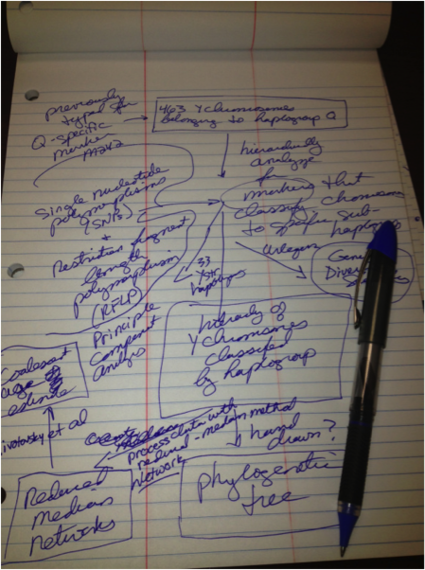
Depict a diagram for each experiment, showing exactly what the authors did. Include as much detail as you need to fully understand the work.
7. Read the results department.
Write 1 or more paragraphs to summarize the results for each experiment, each effigy, and each table. Don't nonetheless try to determine what the results hateful; just write down what they are. You lot'll often find that results are summarized in the figures and tables. Pay careful attention to them! Y'all may also need to go to supplementary online information files to observe some of the results. As well pay attention to:
- The words "meaning" and "not-meaning." These take precise statistical meanings. Read more than about this here.
8. Determine whether the results answer the specific question(s).
What do you think they mean? Don't move on until you accept thought about this. It'due south OK to change your mind in light of the authors' interpretation -- in fact, you probably will if you're still a beginner at this kind of analysis -- but it's a really good habit to starting time forming your ain interpretations before you read those of others.
9. Read the conclusion/discussion/interpretation section.
What exercise the authors think the results mean? Do you hold with them? Tin y'all come up up with any alternative way of interpreting them? Do the authors identify any weaknesses in their own study? Do y'all see any that the authors missed? (Don't presume they're infallible!) What do they suggest to do as a next step? Do you agree with that?
10. Go back to the commencement and read the abstract.
Does it match what the authors said in the paper? Does it fit with your interpretation of the newspaper?
11. Find out what other researchers say about the paper.
Who are the (best-selling or self-proclaimed) experts in this particular field? Do they accept criticisms of the written report that you haven't thought of, or do they generally support it? Don't neglect to practice this! Hither'south a place where I do recommend you apply Google! Merely practice it last, and then you are amend prepared to think critically about what other people say.
A full-length version of this post originally appeared on the writer's personal blog.
Source: https://www.huffpost.com/entry/how-to-read-and-understand-a-scientific-paper_b_5501628
0 Response to "Articles on Scientific Studies on Learning to Read Later"
Postar um comentário